DNA sequencing has evolved from slow, complex methods to fast, automated technologies. Key techniques include Sanger sequencing, sequencing by synthesis, and single-molecule methods like PacBio and Nanopore. These advances have made DNA sequencing cheaper, quicker, and more accurate over time.
6 highlights
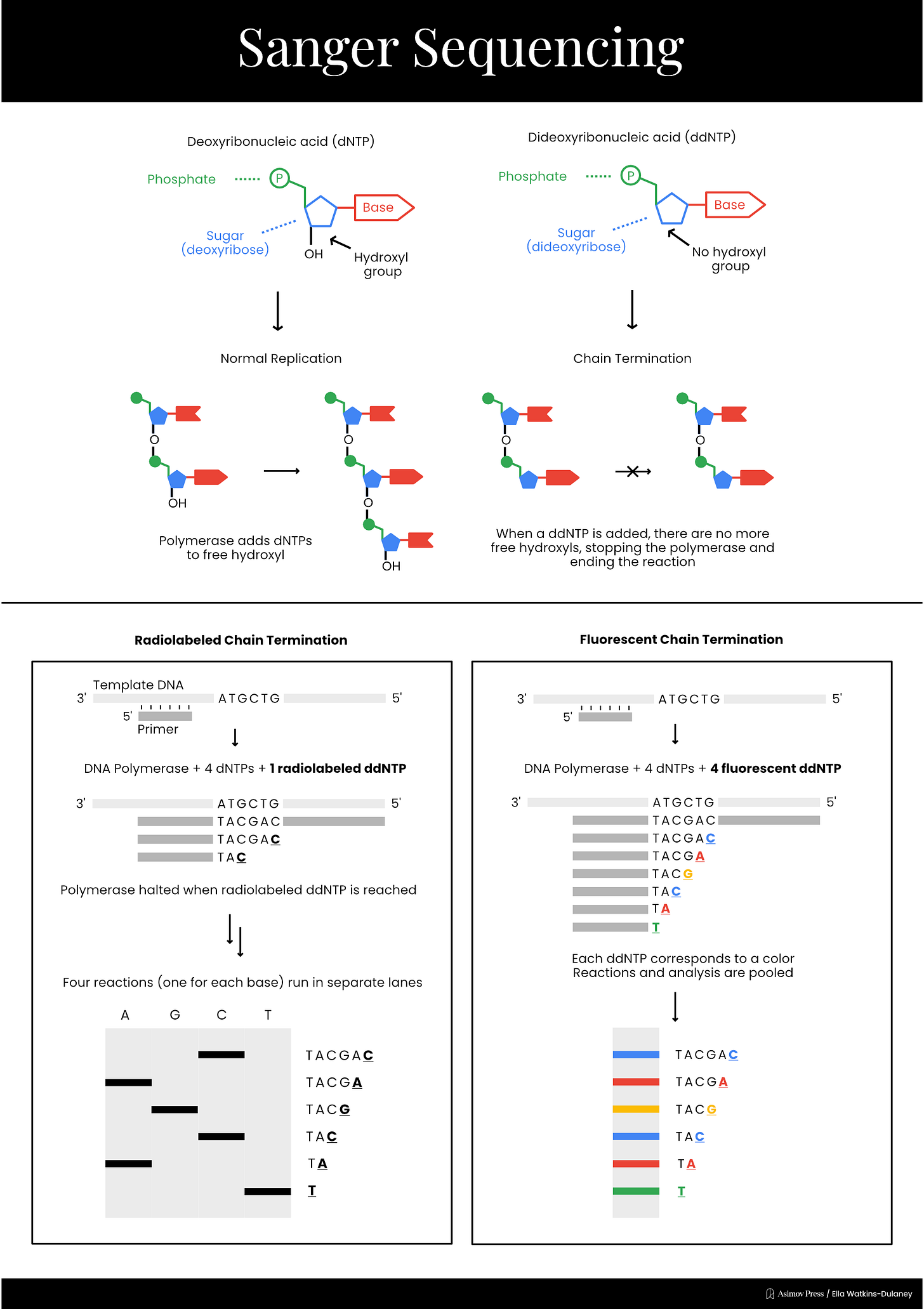
In 1977, Sanger developed a much simpler sequencing method, called “chain termination,” which is today known simply as Sanger sequencing. This technique took advantage of a different type of special nucleotide called a dideoxyribonucleotide, or ddNTP. ddNTPs lack one of the hydroxyl groups present on a normal dNTP, preventing the chemical reaction necessary to add another nucleotide and terminating DNA elongation.
Klenerman and Balasubramanian’s great insight was that template DNA could be sequenced by synthesizing a complementary strand of reversible terminators; basically, extending the chain one base at a time and determining the identity of each nucleotide by looking at the color of its fluorophore.
Unsurprisingly, Illumina has become by far the most common NGS method, maintaining roughly an 80 percent share over the last few years. This is largely owing to its versatility.
Rather than producing short overlapping reads like Illumina, PacBio generates very long reads; at first these were a few thousand bases, but today they can be well over 10,000.
PacBio’s ability to produce extremely long reads makes it a useful complement to Illumina. Indeed, PacBio machines are better at sequencing “confusing” genomes, such as those with many copies of the same gene, long stretches of repetitive motifs, and “structural variations” like large insertions or deletions, which may not show up in short-read sequences.
By 2012, ONT had unveiled its first sequencing data, and Nanopore sequencing quickly established itself as a quick method for generating long reads without DNA synthesis, albeit with a higher error rate than some earlier methods. (Nanopore reads had an accuracy of about 85-90 percent per base in 2017, compared to over 99 percent for Illumina. Recent improvements, though, have boosted this accuracy to more than 99 percent for most applications.)
ONT released its first commercial product in 2015: a handheld machine called the MinION that retailed for just $1000, a fraction of the price of most sequencers.
-
Ah, Peptides. Where to Begin? #
, 5 highlightsYou’re not going to be taking these things orally, because unless a really substantial amount of engineering has gone into it, any given peptide is going get the same treatment from your digestive system as a chicken breast does, i.e. a complete teardown. These mail-order peptides are injectable items.
Unfortunately, point two is that we barely have any of these effects worked out - at least not to the degree that you would want before you start injecting them into your leg. We’re still finding things out about extremely well known active proteins like insulin, much less more recent discoveries. That lack of knowledge extends - and how - both to their on-target effects (assuming that the target or targets are reasonably well known, which isn’t always the case) and to their off-target toxicities.
Excess growth hormone also increases the risk of some types of cancer, and that is a general problem with any attempt to (re)activate cellular growth pathways.
There is no one at the other end of the deal who cares very much, either, believe me. Human nature being what it is in this fallen world, you actually need regulatory agencies to force people to care about these issues by threatening them with severe punishments if they don’t.
The flip side of “the government shouldn’t be able to force me to vaccinate my kids” is “I should have the right to take whatever medicines I want to without the government getting in my way”.
-
What the peptide craze reveals about Americans’ relationship with risk #
, 4 highlightsSynthetic peptides are a broad category of short-chain amino acids that includes familiar, well-studied items like insulin and GLP-1 weight loss drugs.
the risk-benefit calculations of right to try also depend on context, said Knoepfler. It’s one thing for people to take on unknown risks when they’re dealing with serious, often terminal illnesses; another when they’re in overall stable health.
So it’s true that reclassifying peptides might help clean up the supply. But the logic can falter when extended too widely, said Grossman. “If you applied that argument more generally, it would prevent the government from banning almost any substance that people widely demand.”
Whatever research on their risks and benefits eventually shows, peptides are already changing one thing: They’re taking biohacking mainstream, one vial full of unproven potential at a time.
-
CRISPR takes a bold leap toward silencing Down syndrome's extra chromosome #
, 4 highlightsDown syndrome is a genetic condition caused by an extra chromosome 21 (and consequently hundreds of triplicate genes) that leads to developmental and neurological issues.
1 in every 640 babies in the United States is born with DS
In normal development, every biological female has two X chromosomes in most cells. To prevent a double dose of genetic instructions, a gene called XIST naturally shuts down one of the chromosomes.
The team used a modified version of the gene-editing technique CRISPR/Cas9 (often used like molecular scissors to cut or edit DNA sequences) to insert the XIST gene into the extra chromosome 21 to silence it.
-
My patient would rather take a peptide than a statin. That reveals an uncomfortable truth in medicine #
, 4 highlightsIn consumer health culture, the volume of evidence behind a therapy has become inversely correlated with public trust in it.
This result matters because statins remain one of the most refused medications in clinical practice.
But what is happening right now is not the adoption of a promising therapy. It is the wholesale substitution of consumer enthusiasm for clinical evidence.
The deeper problem is epistemological. We have a population that has learned — correctly — that pharmaceutical companies have lied, that institutions have failed them, and that financial incentives distort medical recommendations. The opioid crisis alone justified a generation of skepticism.
But the response has not been better skepticism. It has been the migration of trust from one set of financially motivated actors to another.
-
Memory Safety Is … #
, 3 highlightsNote that the present post is 90% sophistry in the style of Zeno — I don’t think you need a water-tight definition to have a reasonable discussion, and no definition can save an unreasonable one. But thinking about definitions focuses the mind.
NPE
The key detail here is that on the level of abstract semantics, you simply can not have undefined behavior. For the specification to be consistent, you need to explain what the abstract machine does in every case exhaustively, even if it is just “LM gets stuck”. If UB is set complement to defined behaviors, then it is defined just as precisely!
-
Modeling graphs in Rust using vector indices #
, 3 highlightsThe primary disadvantage comes about if you try to remove things from the graph. The problem then is that you must make a choice: either you reuse the node/edge indices, perhaps by keeping a free list, or else you leave a placeholder. The former approach leaves you vulnerable to “dangling indices”, and the latter is a kind of leak. This is basically exactly analogous to malloc/free. Another similar problem arises if you use the index from one graph with another graph (you can mitigate that with fancy type tricks, but in my experience it’s not really worth the trouble).
• The danger of a “dangling index” is much less than a traditional dangling pointer. For example, it can’t cause memory unsafety.
• indices are often a compact and convenient way to represent complex data structures;
-
Exploring Computation Graphs in Rust #
, 1 highlightHowever, making
Nodea trait brings with it the ergonomic disadvantage that nodes often need to be passed around inside aBox, which is slightly annoying. Separately, there is a performance penalty because we are now using dynamic dispatch instead of static dispatch. I don’t think that I care too much about this, because I’m interested in using these graphs with large tensors where the cost of the actual computation will dwarf the cost of traversing the graph. -
Basic Type System Terminology #
, 1 highlightC with its pointer arithmetic, is weakly & statically typed. Python which requires you to explicitly convert between different object types to call the appropriate method, is dynamically and strongly typed.