Many compare India’s economy to China’s, expecting India to follow China’s export-led manufacturing path, but India’s growth is driven mostly by services. India faces challenges like low manufacturing and investment shares and weaker state capacity compared to China. However, India’s fast growth shows it can succeed by building on its own strengths rather than copying China’s model.
-
Two-Sigma Tutoring: Separating Science Fiction from Science Fact #
, 6 highlightsTutors, Bloom claimed, could raise student achievement by two full standard deviations—or, in statistical parlance, two “sigmas.” In Bloom’s view, this extraordinary effect proved that most students were capable of much greater learning than they typically achieved, but most of their potential went untapped because it was impractical to assign an individual tutor to every student.
Cohen, Kulik, and Kulik’s 1982 meta-analysis reported that tutoring effects averaged 0.84 standard deviations when measured on narrow tests developed by the study authors, versus just 0.27 standard deviations when measured on broader standardized tests.
Indeed, Burke wrote, “perhaps the most important part of the tutors’ training was learning to manage feedback and correction effectively.”
Finally, “tutors were urged to be appropriately generous with praise and encouragement whenever a student made progress. The purpose of this training was to help the tutor make learning a rewarding experience for each student.”
The benefits of tutoring depend on how much individualized instruction and feedback students get, how much they practice the tutored skills, and on the type of test used to measure tutoring’s effects.
Producing benefits of one-third of a standard deviation would be a huge triumph if it could be done at low cost, on a large scale, and on a broad test—all without requiring an army of human tutors
-
Empire of AI is wildly misleading about AI water use #
, 6 highlightsRead in this light, the chapter becomes somewhat ridiculous, because the rest includes descriptions of brutal acts of torture and plunder under colonialism, and then frames data center water use as a continuation of that same colonialism.
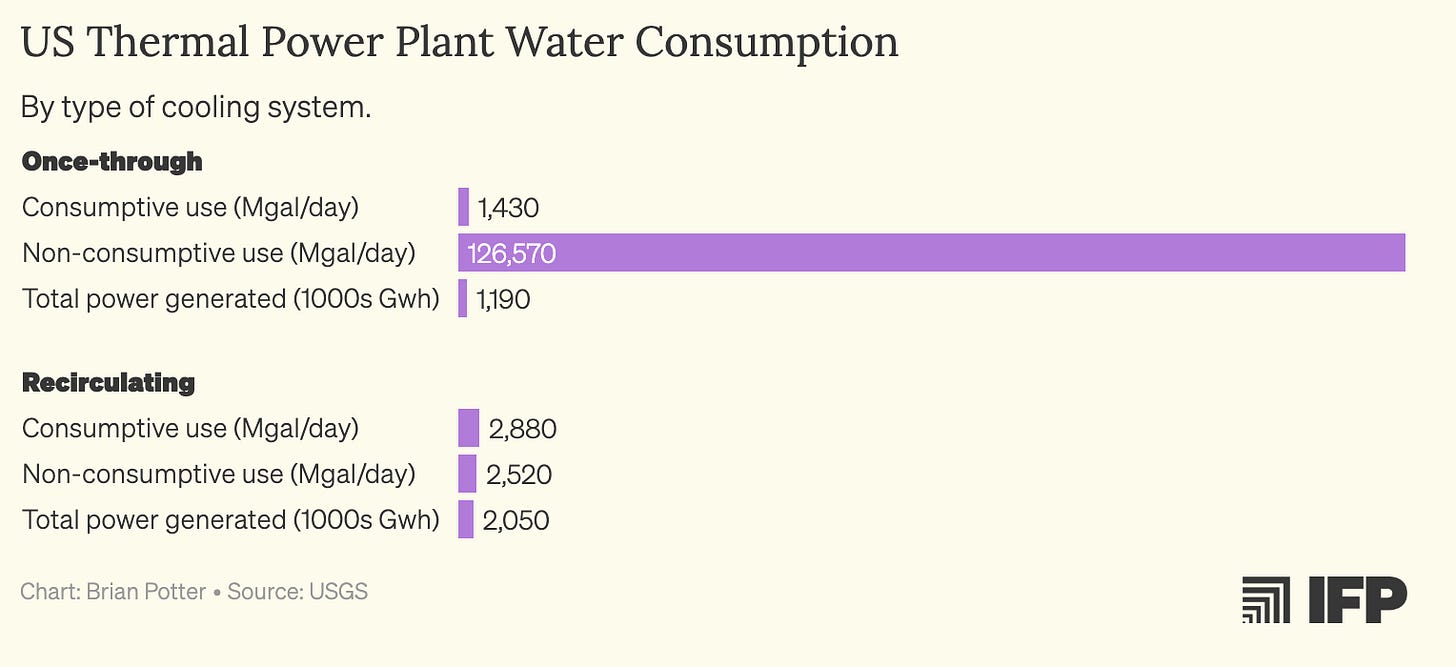
The vast majority of water that power plants use is withdrawn and then returned to the local source (non-consumptive use on this graph).
So the study Hao is citing is not only saying AI will consume just 10% as much water as she says, only 15% of that 10% will be drinking water.
I also argue here that whether water is potable doesn’t really matter, because what actually harms the availability of drinkable water is access to total freshwater, not potable water. It’s relatively easy to turn freshwater potable.
The reason I think this is strange is that in basically every country, including the US, 80% of water is used on industry and commercial buildings rather than household consumption.
-
More on Repealing the Laws of Economics #
, 6 highlightsgovernments can limit the rents landlords can charge for their apartments, but they can’t make developers build new ones.
“protectionism,” because tariffs protect domestic industries from encroachment from abroad
There were a number of reasons for the success of the foreign manufacturers, including quality, engineering and marketing, but one main reason was that consumers concluded that cars made in the U.S. were more expensive than foreign cars but not correspondingly better.
In other words, progress takes countries up the curve from subsistence to prosperity, and along the way they transition from agriculture- to manufacturing- to service-based economics.
he idea that spending shouldn’t exceed revenues is completely out the window. George F. Will listed nine tenets of progressivism in a May 28 article in The Washington Post, and one was as follows: “limitless borrowing from future Americans to fund today’s Americans’ consumption of government goods and services.”
The bottom line on all the above is that free-market economies don’t produce perfect solutions, but efforts to significantly control them make things much worse. There can be no solution that gives everyone what they want. All things considered, however, the laws of economics lead to the best solutions that can be attained.
-
Is It a Bubble? #
, 5 highlightsStruggling with whether to apply the “bubble” label can bog you down and interfere with proper judgment; we can accomplish a great deal by merely assessing what’s going on around us and drawing inferences with regard to proper behavior.
the speculative mania enabled what Perez called the “Installation Phase,” where necessary but not necessarily financially wise investments laid the groundwork for the “Deployment Period.” What marked the shift to the deployment period was the popping of the bubble; what enabled the deployment period were the money-losing investments.
. . . “Inflection Bubbles” – the good kind of bubbles, as opposed to the much more damaging “Mean-reversion Bubbles” like the 2000’s subprime mortgage bubble.
The key realization seems to be that if people remained patient, prudent, analytical, and value-insistent, novel technologies would take many years and perhaps decades to be built out. Instead, the hysteria of the bubble causes the process to be compressed into a very short period – with some of the money going into life-changing investment in the winners but a lot of it being incinerated.
The foregoing is what I call “lottery-ticket thinking,” in which the dream of an enormous payoff justifies – no, compels – participation in an endeavor with an overwhelming probability of failing.
-
Should we worry about AI's circular deals? #
, 4 highlightsThe first is that the deals will artificially inflate companies’ revenue, tricking investors into overvaluing their stock or lending them too much money. The second is that the deals increase systemic risk by tying all of the AI companies’ fortunes to each other.
In fact, I suspect that this is what’s actually going on with these circular deals — diversification. All of these companies are existentially dependent on AI itself, but they don’t want the added vulnerability of being dependent on specific AI companies.
We’ll end up with a system that’s more vulnerable to an AI crash, but less vulnerable to the failure of any specific AI company.
it’s not clear that the circular deals make things worse — instead, they might be letting AI companies diversify their dependencies. In the first quarter of this year, more than half of Nvidia’s revenue came from just four big mysterious customers — probably Amazon, Microsoft, and Google, and possibly Meta. Building up demand from OpenAI could help Nvidia be less dependent on those big customers.