Procrastination often stems from underlying emotional issues, making it more than just a bad habit. Counselors help clients identify irrational beliefs and emotional triggers connected to their procrastination. By addressing these root causes, clients can learn effective strategies to overcome procrastination and improve their overall well-being.
-
Pricing to the demand curve #
, 4 highlightsThe y-axis is the students’ “willingness-to-pay” and the x-axis is the students sorted from highest to lowest bids. The line is known as the demand curve.
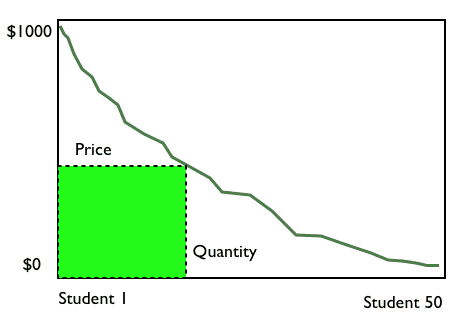
To the right are students who were willing to pay but were priced out. Those are missed sales opportunities. ... Above the green box are students who were willing to pay more than you charged. That is lost revenue.
So the goal of pricing is to capture as much area under the demand curve as possible. In practice, the best way to do this is to find proxies for willingness-to-pay that are easy to observe and that customers will accept.
-
The ‘Arab Spring’ and other American seasons #
, 3 highlightsThe Prague Spring, in contrast, which was a top-down process and not a popular revolt, had the exact opposite agenda – namely, removing the social net from workers and the poor, reducing the institutional protections of workers, seeking alliances with the West, promoting local anti-federalist nationalism, refusing solidarity with popular struggles, liberalising the media, the arts and public expression to allow more western influence in the country and to end agitation on behalf of the working class and, not least, enriching and privileging the new dominant managerial class.
While in the late 1980s and early 1990s, most Soviet and East European citizens had hoped to end the autocratic systems of their ruling Communist Parties and gain western-style political and civil rights, they wanted them not instead of but in addition to retaining those human rights that the Soviet system guaranteed them.
While the US insisted that having the right to work, to free or universally affordable healthcare, free education, daycare and housing (which the Soviet system granted in the USSR and across Eastern Europe as substantive and not merely as formal rights) are not human rights at all, the Soviets, in the tradition of socialism, insisted they were essential for human life and dignity and that the western enumerating of the rights to free speech, free association, free movement, freedom to form political parties, etc., were “political” and “civil” and not “human” rights,
-
Lee was disappointed with India #
, 1 highlight“The average Indian civil servant still sees himself primarily as a regulator and not as a facilitator. The average Indian bureaucrat has not yet accepted that it is not a sin to make profits and become rich. The average Indian bureaucrat has little trust in India’s business community. They view Indian businesspeople as money-grabbing opportunists who do not have the welfare of the country at heart, and all the more so if they are foreign.”